

We’re trained to be *yes people*.
Yes to staying late.
Yes to “just one more project.”
Yes to smoothing egos, yes to people-pleasing, yes to environments that drain us.
It’s the default conditioning of work in a capitalist country: say yes until you forget what no even sounds like.
And yet — the moment we cross into freelancing, contracting, consulting, or solopreneuring, something subtle but radical shifts: the ability to say *no*.

The Yes Economy (Employee Mode)
When you’re on payroll, your body and bandwidth are essentially leased out. The company owns the words you type, the designs you create, and the hours you log. The insurance, the paycheck, the benefits? Those are not gifts. They’re transactions in service of the system — and the system is built to sustain itself, not you.
That’s why “no” is such a dangerous word inside the walls of corporate life.
Say no, and suddenly you’re “not a team player.”
Say no, and HR will remind you what your two weeks’ notice *should* look like — even though that same company could end your employment tomorrow without blinking.
The No Economy (Independent Mode)
On the flip side, freelancers and solopreneurs learn a different language.
No to clients who don’t respect boundaries.
No to contracts that siphon too much energy.
No to platforms we don’t want to play on, conversations we don’t want to have, projects that don’t align.
And here’s the paradox: saying no doesn’t shrink your possibilities — it expands them. Boundaries create freedom. No is not rejection; it’s direction.
Even as a contractor, you get more chances to flex no:
No to extending a contract.
No to overtime.
No to “fitting in” with a culture that doesn’t fit you.
You’re not embedded in the organism; you’re orbiting it.
That gives you leverage.
A Fish Story
In North America, the question we ask most isn’t “Who are you?” or “What lights you up?” It’s “What do you do?”
Action becomes identity.
Productivity becomes proof of worth.
That’s why being a yes-person feels like survival. If you’re not doing, you’re not valuable.
But here’s the quiet rebellion: when you start working for yourself, you learn that saying no is the first step back to *being*.
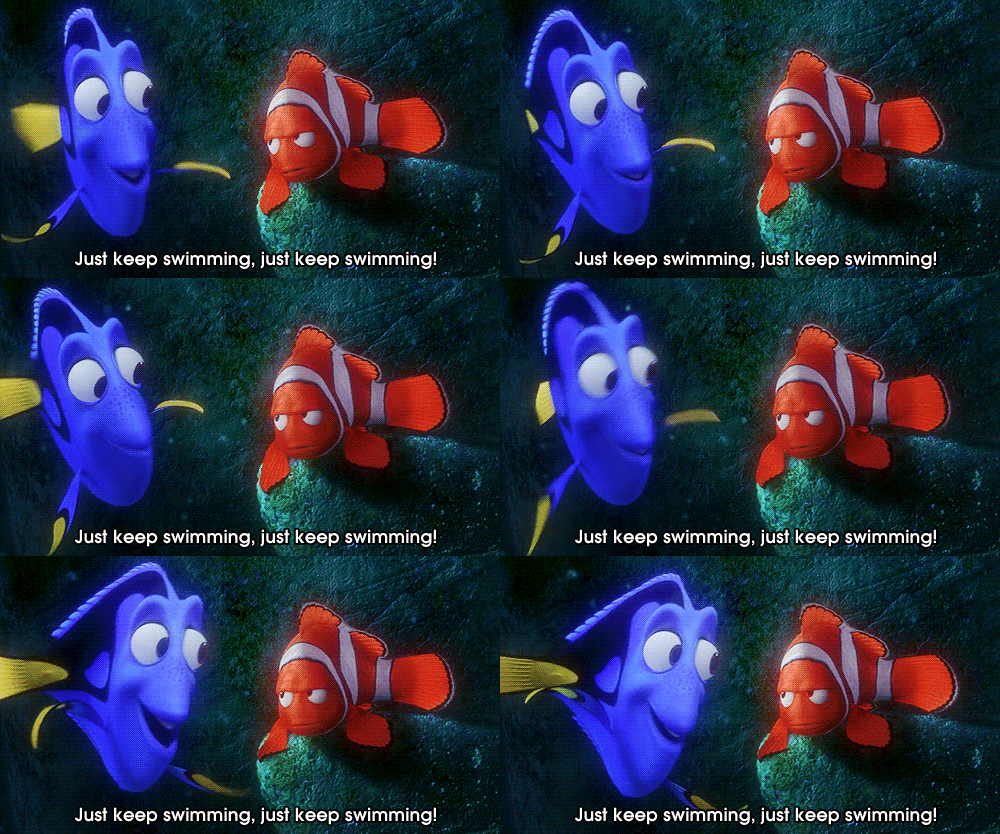
Think of it like this: employees are taught to swim in formation. Same direction, same pace, fins tucked in.
But freelancers and solopreneurs?
We’re still fish — but we get to swim sideways, change colors, dart into new currents. We can join the school when we want, or swim solo when we don’t.
Yes - keeps you invisible in the swarm.
No - lets you be seen in your own light.
The hardest part? Safety.
When you let go of a yes-based career, you also let go of the illusion of guaranteed paychecks. Contractors wait on net-30 invoices. Solopreneurs gamble on products that may or may not sell this quarter.
But that “risk” is also the win. Because for the first time, the yes and no belong to you.
Heads or tails, you hold the coin.
Where This Is Going
I’ll be exploring how these yes/no dynamics show up across different regions and work cultures — because in the U.S., two weeks’ notice is treated like gospel, while in other parts of the world, the rules (and the power) look very different. Stay tuned for that dive.
For now, I’ll leave you with this:
If you feel that tug toward more sovereignty, more space, more no — start small. Contract. Consult. Experiment. See what it feels like to shut your laptop at 5:00, knowing the world won’t collapse.
And if you’re ready to build your own game from scratch — products, services, lifestyle design — that’s the solopreneur’s path. Your rules. Your yes. Your no.