
Coffee and cacao started as parallel stories. Both were indigenous plants. Both were extracted by colonial powers. They diverged because of geography, chemistry, European transformation, and institutional infrastructure. The divergence was not inevitable — it was the result of specific historical choices.
Let’s get into comparing and contrasting these two plants to better understand how we currently consume them, how we currently understand them, and why I specifically choose not to scale my business and make it a point to honor the origin of cacao culturally and not make it another Western “ceremonial” product.
1. Geography — Where the Plants Could Grow
Coffee: The Coffee Belt spans Latin America, East Africa, and Southeast Asia — a huge band of the planet. Colonial powers (Dutch, British, French) were growing it in colonies on multiple continents by the 17th and 18th centuries. Supply scaled fast and globally.
Cacao: Far more geographically finicky. Requires specific soil, humidity, and temperature within ~20 degrees of the equator. A cacao tree takes 3–5 years to produce pods. The supply chain was slower and more fragile to build.
Coffee became globally abundant. Cacao remained relatively scarce and expensive. Chocolate was a luxury product in Europe for most of the 17th and 18th centuries — which is why it never became the everyday drink that coffee did.
2. Chemistry — What Each Plant Does to the Body
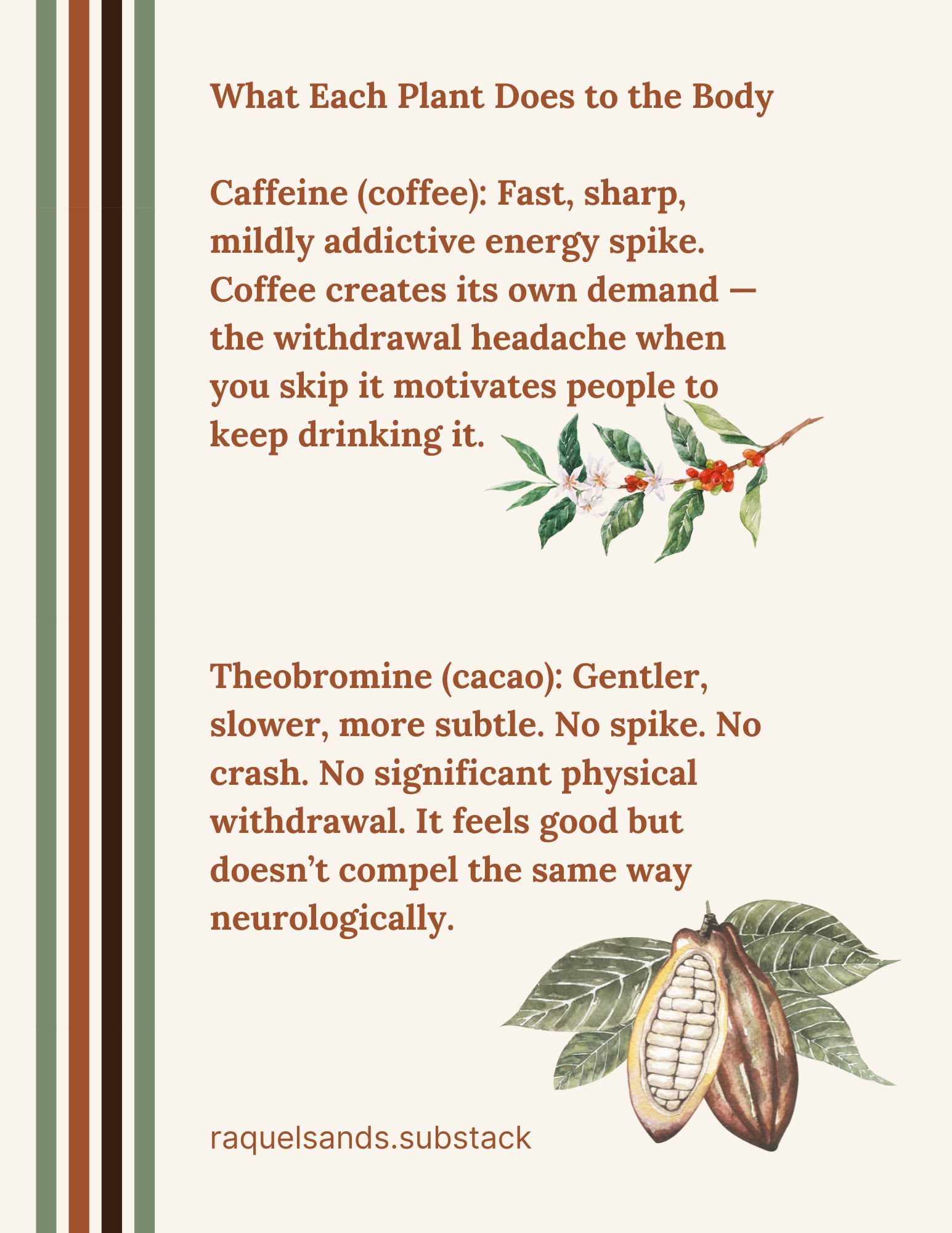
Caffeine (coffee): Fast, sharp, mildly addictive energy spike. Coffee creates its own demand — the withdrawal headache when you skip it motivates people to keep drinking it. From a commercial standpoint, this is an extraordinary feature. A product that physiologically compels habitual consumption.
Theobromine (cacao): Gentler, slower, more subtle. No spike. No crash. No significant physical withdrawal. It feels good but doesn’t compel the same way neurologically.
3. What Colonialism Did to Each — The Identity Question
Coffee: When it arrived in Europe from the Islamic world, it was already a refined drink — bitter, black, prepared with hot water. Europeans essentially kept it the same. The coffeehouse culture that swept London and Paris in the 1600s–1700s served coffee more or less as it had been drunk in Yemen and Ethiopia. Coffee kept its identity crossing the Atlantic.
Cacao: Europeans found the original Mesoamerican drink unpalatable — bitter, spiced, sometimes cold, sometimes fermented. They added sugar, cream, and heat until it became something entirely different: “hot chocolate.” The transformation was so complete that the original plant’s identity was erased. Cacao lost its identity crossing the Atlantic.
Coffee has always been recognizable as coffee across all its variations. Cacao became chocolate, and chocolate has almost nothing to do with the original plant. When people encounter raw cacao today, it feels new and strange. It’s not new — it’s old. It was hidden inside the candy bar for 400 years.
4. The Coffeehouse as a Social Institution
The coffeehouse was one of the most powerful brand vehicles in history.
17th–18th century London and Paris coffeehouses were where merchants met, news was shared, Lloyd’s of London was founded, and the Enlightenment was discussed. Coffee was the drink of intellectual life, commerce, and public discourse.
Cacao was more domestic, more aristocratic (hot chocolate in royal courts), more private. It didn’t have an equivalent public institution.
Coffee embedded itself into the architecture of public social life. Cacao stayed in the home, the court, and eventually the candy aisle.
5. Industrial Scaling — The Chocolate Industry Changed Everything
In the 19th century, when industrial processing of cacao became possible, investment went toward making chocolate bars and cocoa (misspelling of cacao when it translated into other languages) powder — not toward recreating the original drink.
Van Houten invented Dutch-process cocoa in 1828. Cadbury, Nestlé, and Hershey built empires on solid chocolate.
The entire food science infrastructure that developed around cacao went toward confectionery, not beverages. Coffee infrastructure went toward perfecting the brew.
By the time anyone wanted to sell raw cacao as a drink again, it was competing against a $200 billion global chocolate industry that had spent 150 years telling people that cacao = sweet chocolate.
6. Surprise exploration: Matcha
Matcha’s trajectory: Japanese green tea had been a ceremonial drink for centuries. It came to Western markets in the late 2000s, positioned as a health-conscious coffee alternative. It went from niche to mainstream in about 10 years — largely because Starbucks put a matcha latte on the menu in 2006, Instagram made the green color photographable, and the wellness industry adopted it as a superfood.
The “ceremonial grade” pattern: Matcha borrowed the “ceremonial grade” framing from Japanese tea ceremony and it worked commercially. The problem: “ceremonial grade matcha” is also largely unregulated. But the term traveled and consumers accepted it.
Where cacao differs from matcha….
Cacao has a more complicated story because it has to compete with the cultural dominance of chocolate. Matcha didn’t have to overcome 400 years of a global candy industry telling people what it was. But cacao’s culture is genuinely 5,000 years old — matcha had to borrow the ceremony language. Cacao’s authenticity is structural, not borrowed.
Now, all of this leads me to why I don’t want to scale my small one-woman business.
When I first had the idea to sell cacao, I didn’t mean cacao by itself. I mean cacao drinking blends. I blend other spices and herbs into the cacao to create different effects and complement the base, which is always the cacao.
My heritage was the first thing I thought of, because I’d been drinking cacao on its own for years. I’ve had it the way Indigenous peoples drank it, with chili powder and vanilla. I’ve had it with black pepper and turmeric, with just honey, and as an almond milk latte with almond foam.
How does cacao connect me to my heritage?
I’m first-generation. My family lineage is entirely from Central America and isn’t connected to the United States at all, and my cousins and I are the first born in this country. When I learn about World War I, World War II, Korea, and Vietnam, I find no connection to my family or my heritage. I didn’t grow up on that side of the border or on that land.
Cacao is my tether. It lets me travel to that land energetically and keep strengthening my roots with my culture in a way that feels close, intimate, and sustainable. I wanted to give other people that same closeness and groundedness.
Why I started a cacao business
I love business. I love the idea of having autonomy over my time and energy, and of making money and meaning in a way that feels creative and sustainable.
I did career coaching for a while, and nothing clicked. I’ve been a career nomad and a job hopper my whole career. I knew a system that constantly asks you to contort yourself to provide for yourself would never be sustainable for my creativity. So I decided to try selling my cacao blends at local farmers’ markets. That honors my heritage and my ancestors, and it lets me create something with people.
Why I don’t sell “ceremonial grade” cacao
Entering this market has hurt my heart a little. I’ve watched how cacao gets marketed, which maybe isn’t surprising given the economy and social structures most of the world lives in.
I knew I didn’t want to be part of westernizing cacao. I didn’t want to be spiritually elite or gatekeep. And “ceremonial grade” isn’t a real, regulated thing. The cacao products I make honor their ancestors from Central America. I want to bring cacao, my specific blends, and all of their history, culture, legacy, and evolution to people in a relational way. I want it simple, not complicated, in both the products and the marketing.
Why I’m keeping my cacao business small on purpose
Maybe this way takes more time. Maybe it’s a slower burn, and I don’t know if it will become sustainable enough to rely on for income. But I’m learning not to define it or contort it. A cacao plant takes time to grow, and certain conditions have to be right for it to flourish. I think a business works the same way.
I don’t know what the economy, the market, or people’s tastes will do. I can only stay grounded in my sincerity, my effort, and the relationships and community I want to be part of. I’m happy to let this be small and mighty and true.
I’m not interested in thousands of employees, a conglomerate, or a chain of offices. I’m content, satisfied, and joyful keeping this small. I do want it to grow, though.
Where can you buy my cacao blends online?
I launched my online shop, and I currently operate under Virginia cottage food law. That means I can only ship within the state of Virginia, and all you need is a Virginia address.
My goals for growth:
A commercial kitchen, so I can ship to other states
A bigger online presence, so this can become a steady part-time income
Giving back to causes close to my heart: the environment, women, education, youth, and mental health
More cacao recipes and, eventually, body care products, always made with creativity and environmental consciousness
What makes Sands & Semilla different from other cacao companies?
My blends are rooted in a specific heritage and a specific relationship with the plant. I’m not selling an aesthetic or a spiritual hierarchy. I’m trying to get to the heart of cacao, its core and its essence, and share it simply with the people I meet.
That’s my business plan, and it’s what I think sets me apart from the other cacao drinking blend companies you’ll find online.
FAQs
Is Sands & Semilla cacao ceremonial grade?
No. “Ceremonial grade” isn’t a regulated term, so I don’t use it. My blends honor cacao’s Central American ancestry without that label.
Does cacao have less caffeine than coffee?
Yes, noticeably less. It’s about a tenth of coffee’s caffeine, which is why it feels calmer.
Where do you ship?
Within Virginia only, for now. I operate under Virginia cottage food law.
What’s in a cacao drinking blend?
Cacao plus spices and herbs, such as vanilla, cinnamon, and cardamom.
Share this with a friend: