

There are brands out there — maybe you've seen them — selling “ceremonial” cacao.
Beautiful packaging. Earthy tones. Language about ritual, about heart-opening, about ancient wisdom. The founder is white. The cacao comes from Guatemala, Ecuador, or some other Latin American country.
I don’t know how much the farmers get paid.
I don’t know if there’s a fair trade certification, a community reinvestment fund, or a genuine relationship with the people whose hands touched that cacao first.
Maybe there is. But I notice something when I look at the brand: the face of it is not the face of where the plant/and the plants’ people come from.
And that noticing — that small, persistent itch — is hard for me to scratch.
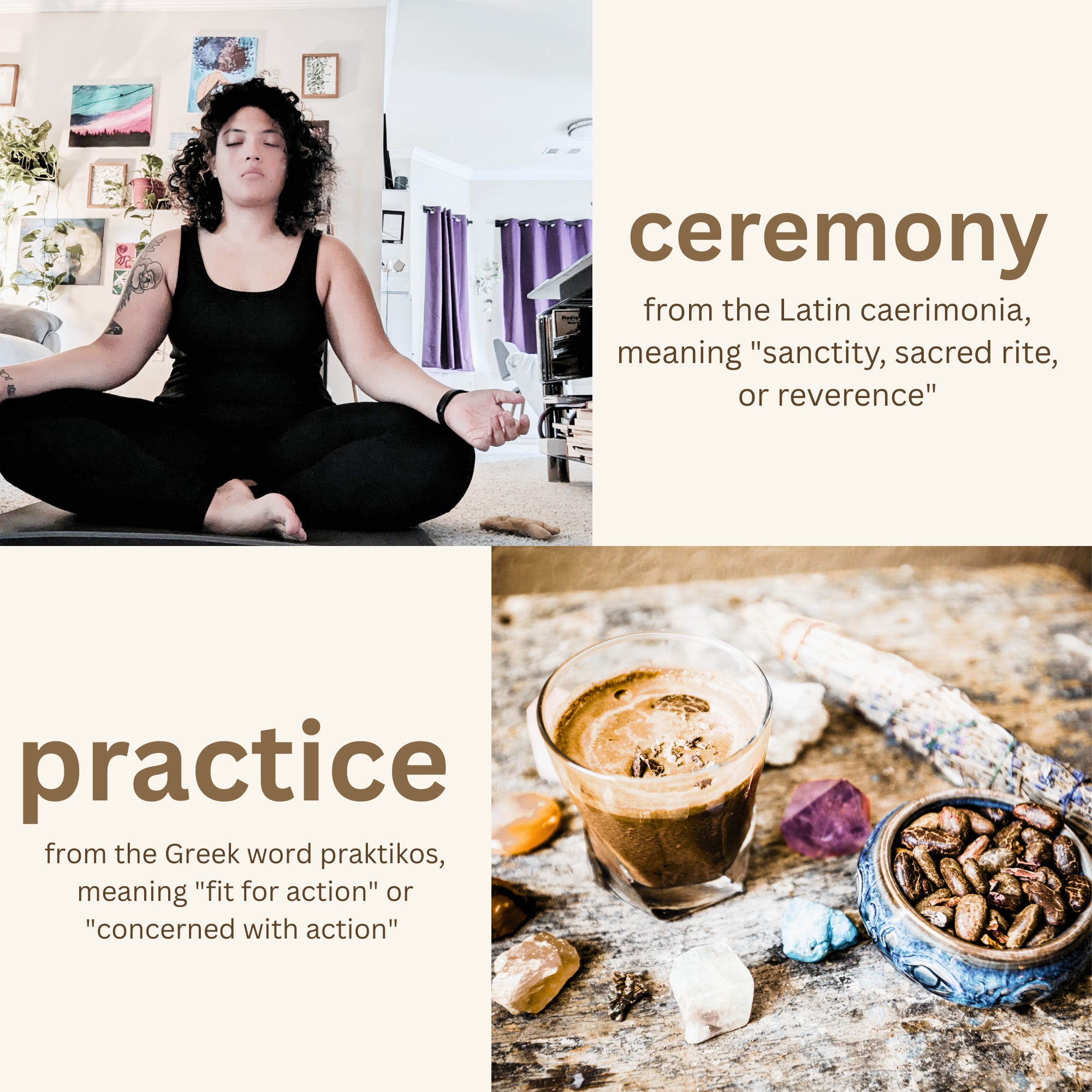
Because this isn’t new. This is a pattern. Yoga. Sage. Ayahuasca. Kambo — the frog medicine from the Amazon. Matcha elevated to a $14 latte. Cacao transformed from a kitchen staple in my grandmother's house into a "ceremonial experience" that can cost $40 a bag.
There is a throughline. It usually goes like this:
a white person (or a Western brand) discovers something from a Black or brown culture. They fall in love with it — genuinely, often. They feel called to share it. And then, because they exist inside a system that rewards commodification, they build a business around it.
The original communities — the ones who held this thing, who passed it down, who never separated it from its spiritual and cultural context — often didn't commercialize it.
Not because they lacked entrepreneurial spirit. But because some things weren't for selling.
Or because they didn't have access to the capital, the platforms, the social trust, the permission that the marketplace quietly extends to some people and quietly withholds from others.
And then someone else does it for them. And profits from it. And becomes the expert on it.
Let's talk about cacao specifically.
Cacao is Mesoamerican. It is Mayan, Aztec, and Olmec. It is from the same soil that my ancestors walked.
It was medicine, currency, and ceremony — not separate things, the same thing.
When I see a white woman in linen pants leading a "cacao ceremony" on a retreat in Tulum, Mexico, I'm not just seeing cultural appropriation as a concept. I'm seeing the continuation of a very old story: the extraction of value from land and people who were never fully compensated — economically, politically, or spiritually — for what was taken.
The colonizers came for gold, cacao, rubber, and bodies. They didn't leave. The methods changed.
And then my husband asked me something that stopped me.
What if the indigenous community doesn't accept you either?
I sat with that for a moment. And I said, it would hurt. But I would do my best to respect their wishes and do something else with my passion and time.
That answer surprised even me.
Because I have ancestry that connects me to this plant — Central American roots, West African roots, a lineage that held cacao long before it was a brand. And still, I'm willing to be turned away.
Still willing to say: your right to define your own sacred things is more important than my desire to be included.
That posture — the willingness to ask permission and genuinely accept no — is exactly what's missing from most of these conversations. Most people who appropriate never even ask the question. They discover something, fall in love with it, and the love feels like enough justification.
It isn't.
The "local" problem
This conversation got more complicated when I was navigating a farmers’ market application that prioritized locally sourced products.
And I found myself asking: What does local even mean when cacao cannot grow in Northern Virginia?
The plant's native origins are in South and Central America. My ancestral relationship to it is older and more intimate than any supply chain. And yet a market framework built around a particular geography would categorize me — and cacao — as not local enough.
This is what broken frameworks do.
They were built around a certain kind of producer, a certain kind of place, and they quietly exclude the very people whose relationship to an ingredient is the most local relationship that exists. I am more local to cacao than the soil I'm standing on ever will be.
My husband pushed further.
But what if someone else could just sell it better than you? What if they're genuinely more talented at business?
And this is where I had to name something I've been circling for a while.
We have so thoroughly internalized the market as the final judge of worthiness that selling skill has become confused with the right to a thing.
Better at commodifying equals more deserving?
More gifted at extracting value equals closer to the source?
I don’t believe it works that way. A talented salesperson can sell anything. That is not a spiritual credential. That is not a relationship. That is not lineage.
And yet this is the logic that has always justified extraction — the idea that if you can profit from something more efficiently, you have earned some claim to it. We've seen where that leads.
Money is a disease.
I don't say that lightly as someone actively building a business.
I say it because I think it's true, and I think sitting with the contradiction is the only honest way to move forward.
When money becomes the measure of whether something should exist, whether a culture has value, whether a person deserves access — that is a pathology. Priceless things get priced. Sacred things get packaged. And the communities that held them sacred are left watching someone else collect the margin while being featured as a paragraph on the About page.
The question I keep returning to is not can I sell this? It's does this need to be sold?
Just because you love something, just because you see an opportunity, does not mean that commodification is the right next step. Sometimes the most radical thing you can do is resist that pull entirely.
I haven't fully resisted it.
I'm building Sands & Semilla — a small-batch cacao brand rooted in my Central American and West African ancestral heritage. I've made a choice to enter this market. And I carry that choice with weight, with accountability, with a commitment to being as close to the root as I can get.
Not because I'm certain I'm doing it right. But because I keep asking whether I am.
So where is the line?
I don't think there's a clean one.
Culture has always moved and mixed. But I think the line has something to do with power — who holds it, who benefits from it, and whether the people closest to the origin are in the room.
Some questions worth sitting with before you build a brand around someone else's sacred thing (or to ask yourself for your own culture/sacred things):
- Are the people who come from this tradition compensated proportionally — not just charitably?
- Are they visible as partners and decision-makers, not just as a sourcing story?
- Are you learning from them or learning about them?
- What would it mean to be a bridge rather than the destination?
- And honestly — does the world need you to do this, or does it need you to fund and amplify the people who already are?
We are not living in a post-colonial world.
People are undocumented because of what imperialism did to their countries.
People are refugees because of what capitalism extracted.
Families like mine are first-generation born inside the empire that destabilized the places their parents fled.
These aren't historical footnotes. This is still the water we're all swimming in.
Just because you can doesn't mean you should. And just because you mean well doesn't mean the harm isn't real.
My husband asked what if I can't sell it as well as someone else. And I thought — maybe that's not the point.
Maybe the point is that some things shouldn't be optimized. Maybe the most radical act isn't building the best brand.
It's being someone who asks whether it should be a brand at all. And then choosing, with full awareness, with grief and gratitude and accountability, to do it anyway — as carefully, and as close to the root, as you can get.
Thank you for these reflections. I'm sitting with so much of what you wrote, especially your final note: "Maybe the point is that some things shouldn't be optimized. Maybe the most radical act isn't building the best brand. It's being someone who asks whether it should be a brand at all. And then choosing, with full awareness, with grief and gratitude and accountability, to do it anyway — as carefully, and as close to the root, as you can get." I appreciate you.