

The light changes. The year begins to lean toward its ending. We start making lists—gifts to buy, plans to make, things to finish before the calendar turns. In the United States, Hispanic Heritage Month runs from September 15 through October 15, so this is also a moment when public attention turns, however briefly, toward the histories and contributions of Hispanic and Latino communities.
And then, just beyond that window, comes Día de Muertos: a tradition that asks us to make room for memory.
I want to approach it with curiosity and care—not as a seasonal mood board, not as a synonym for Halloween, and not as if one essay could explain a tradition that lives differently across families, regions, and communities.
What Día de Muertos is—and what it isn’t
Día de Muertos, often observed on November 1 and 2, is a living tradition in Mexico and in Latin American communities around the world.
Families may create ofrendas—offerings or altars—with photographs, candles, flowers, favorite foods, drinks, and objects that belonged to or remind them of people who have died. The point is not simply to represent death, but to continue a relationship with those who are gone.
There isn’t one universal way to observe it. Practices vary by region, Indigenous community, family, faith, and personal history. For many communities, the tradition brings together Indigenous worldviews and practices with Catholic observances introduced during Spanish colonization. That history is layered, and it should not be reduced to a neat story of two cultures blending happily…
Hispanic Heritage Month: a useful frame, an imperfect container
In the United States, National Hispanic Heritage Month runs from September 15 to October 15. It began in 1968 as Hispanic Heritage Week, established through congressional action during President Lyndon B. Johnson’s administration. In 1988, Congress expanded it to a month-long observance, signed into law under President Ronald Reagan.
The dates are not arbitrary: September 15 marks independence anniversaries for Costa Rica, El Salvador, Guatemala, Honduras, and Nicaragua. Mexico celebrates its independence on September 16; Chile’s is September 18. The month recognizes histories and contributions connected to Spain, Mexico, the Caribbean, and Central and South America. But the umbrella can be both useful and limiting.
“Hispanic” often points toward Spanish language or Spanish-speaking heritage; “Latino” generally points toward Latin American origin. Neither term describes everyone in the same way, and neither erases differences of race, Indigenous identity, language, nationality, migration, or personal preference.
Brazil, for example, is part of Latin America but Portuguese-speaking. Many Indigenous communities have languages and identities that predate and exist beyond Spanish colonial categories.
An identity label can create recognition. It can also flatten. It can help people find one another while obscuring how different their histories are.
And that raises a question I keep returning to: What does it mean to belong to a culture? Is it ancestry? Language? Place? Family practice?
The stories we were told—or the stories we are only now trying to recover? What if we feel connected to something but don’t feel entitled to claim it? What if we have inherited a culture through distance, silence, migration, assimilation, or loss?
There is no single answer that fits everyone. But I think it matters to ask the question without treating identity as a test people must pass.
Memory is a practice, not just a feeling
What moves me about Día de Muertos is the idea that remembering can be active.
A photograph is placed somewhere visible. A favorite dish is made. A candle is lit. A name is spoken. A story is told again—not because the person has become a symbol, but because they remain part of the shape of a life.
We all have ways of carrying people with us. Some are inherited. Some are improvised. Some are religious or cultural; others are private and ordinary. A recipe, a phrase, a song, a way of tending a garden, a particular kind of generosity. Sometimes we keep a practice because it connects us. Sometimes we return to it after years away. Sometimes we discover that a story we thought we knew was incomplete.
As the year begins to close, I find myself thinking about what we carry forward and what we can finally set down.
Not everything we inherit needs to be kept exactly as it was handed to us. Not everything we let go of was meaningless. Some things need reclaiming. Some need grieving. Some need to be learned properly before we claim them. Some belong to other people, and our role is to honor that boundary.
Maybe transition asks us to notice what deserves our attention—and what has been taking up space simply because we never paused long enough to question it.
A small invitation for this season
You don’t need to build an ofrenda to take something from this reflection, and you don’t need to borrow someone else’s ritual to honor your own memories.
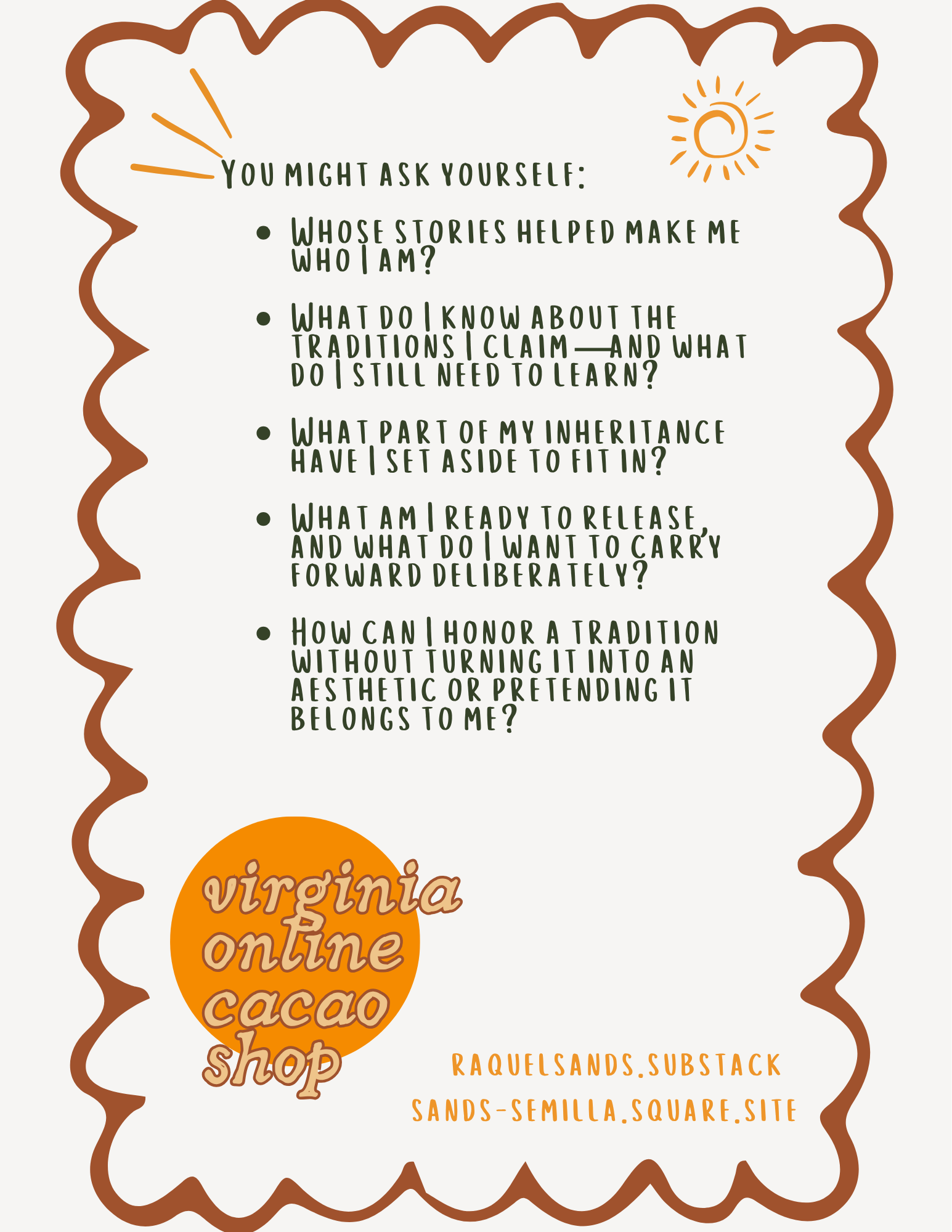
You might ask yourself:
Whose stories helped make me who I am?
What do I know about the traditions I claim—and what do I still need to learn?
What part of my inheritance have I set aside to fit in?
What am I ready to release, and what do I want to carry forward deliberately?
How can I honor a tradition without turning it into an aesthetic or pretending it belongs to me?
Perhaps the most respectful place to begin is not with decoration, but with attention. Learn from people who live the tradition. Read sources created by the communities themselves. Support their artists, museums, and cultural organizations. Make room for difference instead of searching for one tidy definition of what a whole people believe.
And then, in whatever way is genuinely yours, make room for memory.
As the year turns, may we be thoughtful about what we receive, honest about what we have lost, careful about what we claim, and gentle with the parts of ourselves that are still becoming.
Not every ending needs to be rushed. Not every beginning needs to be announced. Some things ask us simply to pause, remember, and choose what we will carry.
Share with a friend!
A few places to keep learning
UNESCO, “Indigenous festivity dedicated to the dead”: https://ich.unesco.org/en/RL/dia-de-muertos-the-indigenous-festivity-dedicated-to-the-dead-00054
National Museum of Mexican Art, “Día de Muertos, Where the Past Is Present”: https://nationalmuseumofmexicanart.org/events/dia-de-muertos-where-the-past-is-present
U.S. National Archives, “Hispanic Heritage Month”: https://www.archives.gov/news/topics/hispanic-heritage-month
National Park Service, “What’s in a Name? Identity, Terminology, and Latino Heritage”: https://home.nps.gov/articles/000/what-s-in-a-name-identity-terminology-and-latino-heritage.htm
Smithsonian Institution, “Cultural Appreciation vs. Cultural Appropriation”: https://www.si.edu/es/object/cultural-appreciation-vs-cultural-appropriation-conversation-alaska-native-artists%3Ayt_V4L0dP1mPM4
*This essay is an invitation to learn, not an attempt to speak for every Mexican, Indigenous, Hispanic, or Latino community. Día de Muertos is diverse and living; the most respectful approach is to keep listening to the people and communities who sustain it.*