
Here’s my stance: I don’t have to agree with someone to understand them.
We are billions of people sharing the same land, the same air, the same water, the same dying and decaying matter that feeds the next generation of plants and animals we’ll eventually eat too.
Nothing is actually extracted and owned in some final sense — everything is shared, cycled, passed through.
And yet we behave as if the goal is to arrive at one shared, agreed-upon definition of how to live, what’s right, what’s true. We reach for agreement like it’s the destination.
I think that reach is not just unfair — it’s illogical. It doesn’t match the actual shape of reality, which is plural, shifting, and irreducibly perspectival.
Maybe the only thing we can honestly agree on is that we’re not always going to agree. That life is mutual and ever-changing. And that’s it. That’s the ceiling.
Because the moment we push past that into “let’s all agree on this label, this definition, this way of existing” — we’ve entered the territory of let me tell you how you’re doing it wrong. Let me tell you why you’re wrong, and I’m right. And underneath all of that, I think, is the same aching want: to be understood. To be seen, heard, felt.
That might be the most distinctly human thing there is — this desire not just to exist but to be recognized in our existence. Other animals express themselves too — the whale songs, the bird dances, forms of communication we may never fully translate — but I don’t know that other animals reach for definition the way we do.
We seem to have a unique hunger to take understanding and put it in a box. To limit it, refine it, make it efficient enough to extract from.
The Etymology of Reduction
I keep coming back to the words themselves. To know something assumes a finite, graspable conclusion. To agree assumes a shared, settled endpoint. But to understand — to stand under something — doesn’t require arriving anywhere. It just requires proximity. Attention. A willingness to be near what you don’t fully grasp without needing to resolve it into something smaller and safer.
Knowing and agreeing are both, in their own way, acts of containment. And I think that containment is exactly the move we make when something feels too big, too messy, too alive to sit with as it is. We refine it. Like wheat.
Take the myth of the United States — the story of freedom and bravery it tells about itself. The actual history is a lot messier: settlers who came fleeing debt, settlers sent as punishment, settlers chasing reinvention, settlers running from things we’ll never fully know. That messy, whole-grain origin has been milled and sifted and refined for centuries into something else entirely — white bread.
Something with the fiber and complexity removed, baked into a clean, marketable idea: global superpower, home of democracy, moral high ground — even while that same country does duplicitous, hypocritical things to countries it calls “third world,” and discriminates against people born within its own borders whose families carry lineages from somewhere else. Like mine.
We are so far past the first chapter of that story.
Whatever innocent thought or claim it might have started as has been kneaded, cut, cooked, and shaped into something rigid and defended. That’s what happens when the impulse to define wins out over the willingness to understand. We don’t just simplify — we lose. We reduce the very thing we were trying to make sense of in the first place.
The Package on My Doorstep
A few weeks ago I ordered some clothes online. First time in my entire life something like this has happened — the delivery photo showed the package sitting in the mail area of my apartment building. I knocked on a neighbor’s door to check. They confirmed: yes, it had been there. But by the time I went to get it, it was gone.
Stolen. Or maybe just moved — though if it was an accident, wouldn’t it have turned up somewhere?
I sat with that feeling for a while. Dumbfounded. Genuinely confused. Who takes something without knowing what’s inside it — the size, the fit, whether it’s even something they’d want? Who takes just for the sake of taking?
I don’t think I’ll ever land on a satisfying answer. And I think that’s actually the point.
Some things resist being understood, fully, and that’s allowed to be true. But the attempt — the willingness to sit in the not-knowing instead of slamming a verdict down just to make the discomfort stop — that’s the muscle I’m trying to build. Not because I’m bypassing the loss or excusing the person. Because staying in the question, rather than rushing to a tidy conclusion, is its own kind of respect for how complicated people and situations actually are.
Where This Gets Harder
I want to go further into the uncomfortable territory, because I think that’s where understanding actually matters — not in the easy cases.
We can talk about the patriarchy, about how men are socialized, cultured, systematized, even shaped biologically in ways that contribute to domination-based systems. There’s a real argument there.
We can talk about racism — about the fact that the majority of the world is Black and Brown, and the minority is white, and yet so much of media, wealth, and power has been claimed and defended by that minority.
I sit with that disproportion, and I wonder — not to excuse it, never to excuse it — what it is, collectively, within a group of people that made them feel entitled to dominate. To enslave. To torture. To take up that much space.
I think about it sometimes almost like a prey-versus-predator instinct — being a minority and reaching for a kind of oversized power as compensation, as armor, as a way of never being outnumbered again. I’m not saying that’s right. I’m not saying it’s an excuse. It isn’t.
It’s a possible thread of understanding, not a verdict of forgiveness.
Same with the people swept into regimes like the Nazis — the brutal binary logic of comply, or your family suffers. I can trace that logic without ever placing compassion where it doesn’t belong — on the slaver, on the perpetrator. Understanding the mechanism is not the same as absolving the choice.
This is the distinction I keep circling: to understand is not to accept, not to agree, not to say I know, right? and move on. It is to genuinely ask — why do I feel this way? Where was this taught to me? What is being triggered in me right now? What is it about this person or this moment that’s ruffling my feathers? That kind of self-interrogation is uncomfortable. It’s supposed to be.
So many religious texts and mythologies across cultures circle this same idea — let the one without sin cast the first stone. Because looking inward honestly, without the shortcut of moral certainty, is one of the hardest things a person can do.
What Understanding Actually Grows
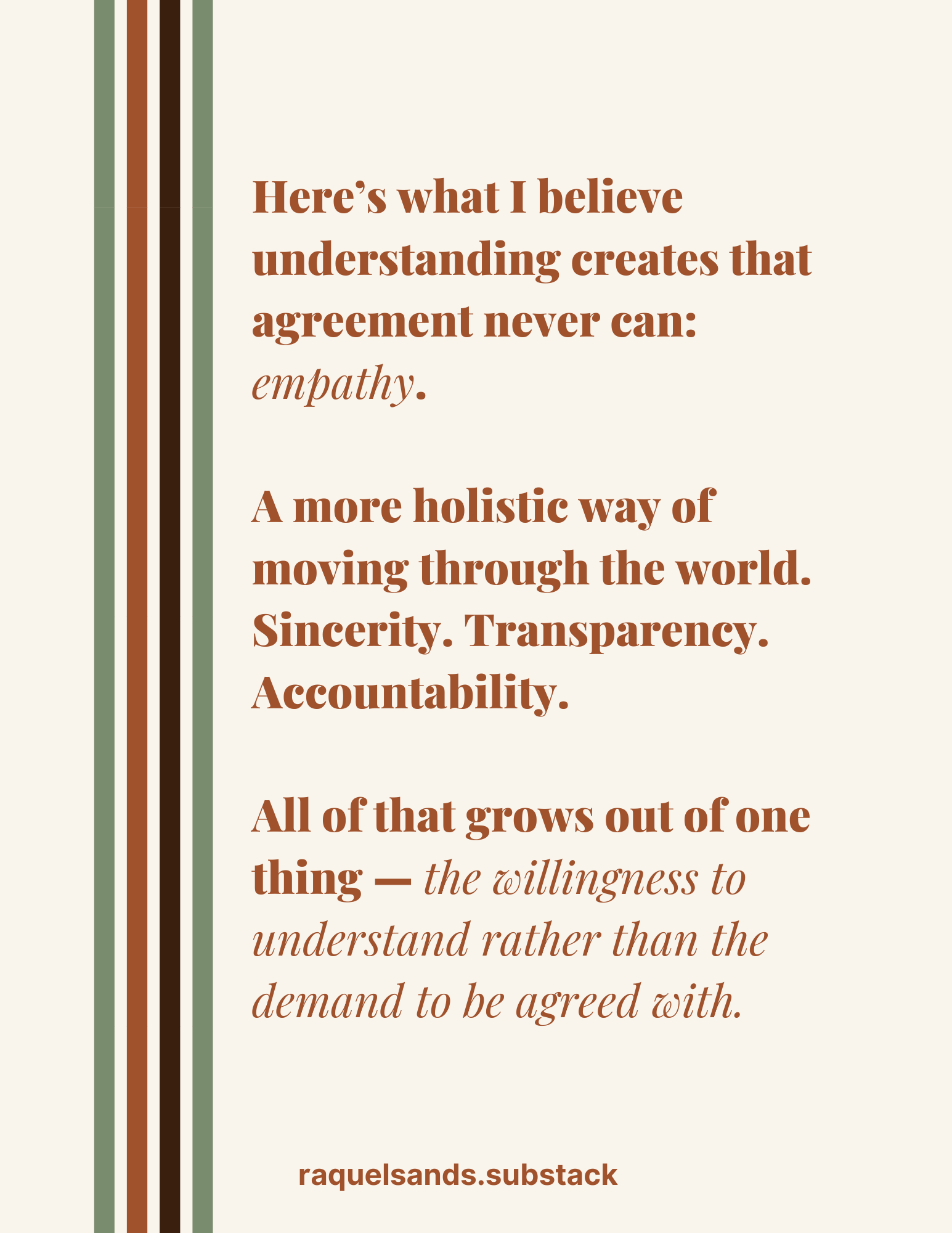
Here’s what I believe understanding creates that agreement never can: empathy.
A more holistic way of moving through the world. Sincerity. Transparency. Accountability. All of that grows out of one thing — the willingness to understand rather than the demand to be agreed with.
And this is the work, I think — not just of activism or philosophy, but of an ordinary life. Building something for myself. Nourishing my body. Drinking cacao slower than I want to. Walking my dog and doing the daily, unglamorous things that ask me to actually be present with myself, instead of managing myself into a shape that’s easier to defend.
All of it is in service of understanding — myself first, and then, by extension, everyone else I’m sharing this air and land and time with.
Because if all we’re here to do is consume and accumulate and eventually die, then what was the point of any of it — the experiencing, the expanding, the expressing, the enduring?
Life was never meant to be comfortable, or nice, or resolved into agreement. If it were, we wouldn’t grow. We wouldn’t be challenged. We’d just be still.
To understand is to grow. To seek understanding — of ourselves, of the people we love, of the people we can’t stand, of history, of biology, of grief — is to keep pressing on our own values instead of letting them calcify into certainty. It’s uncomfortable work.
But it might be the actual work of being human.
I don’t need you to agree with any of this. I’d love for you to sit with it a little.
Share with a friend: