You can be brilliant at your craft.
You can deliver flawless work, solve problems others can’t, and bring a level of creativity that turns heads.
But here’s the truth most people don’t want to admit: **if your profile, website, or portfolio looks outdated or confusing, you’re invisible.**
Not because you’re not talented.
Not because people don’t need what you offer.
But because you’ve fallen into the most common trap of professionals, freelancers, and solopreneurs alike:
Thinking the work will speak for itself.
It won’t.
Why This Mistake Happens
We get it drilled into us from school and our first jobs: if you *work hard enough*, *be good enough*, and *deliver consistently*, recognition will follow.
Promotions, referrals, clients—it’ll all line up.
But in the real world, attention doesn’t flow to the most talented. It flows to the most visible.
That means:
If your LinkedIn headline still says “Marketing Specialist” but you’ve been doing senior-level strategy for years—you’re underselling yourself.
If your website feels like a résumé from 2014, with tiny text and a wall of jargon—you’re losing people in the first ten seconds.
If your portfolio has no through-line or narrative, just random uploads—you’re making it hard for anyone to connect the dots.
And here’s the kicker: nobody will stop and ask you to clarify.
They’ll just move on.
The Harsh Reality of First Impressions
We live in a swipe-and-scroll culture.
People don’t sit down with a coffee to dig into your 15-page case study.
They’re skimming.
Recruiters are scanning dozens of profiles in an hour.
Potential clients are comparing you to three other tabs they have open.
Even your network—the people who *want* to recommend you—won’t if they can’t easily articulate what you do and why you’re the best fit.
It’s not fair, but it’s real:
**you can lose opportunities you deserve simply because your digital presence is working against you.**
What “Invisible” Looks Like in Action
Here’s what invisibility often shows up as:
You’re getting views on LinkedIn, but nobody reaches out.
People tell you “You’re so talented!” but never actually send clients your way.
You spend weeks applying to opportunities and hear crickets.
Or worse—you land the conversation, but they assume you’re junior, outdated, or “not quite the right fit” based on the online version of you.
Meanwhile, someone less experienced than you—who simply looks polished and clear online—gets the gig.
In other words…
The ocean of opportunities only goes to the big fish and seagulls (those on the surface who get all the attention), not all the rest, who are equally, if not more, needing and deserving.
Visibility Is a Skill
The good news? Visibility is a system.
“Luck,” manifestation, prayer, all the invisible things we lean on and into, take work.
Consistent tweaking and checking in.
It’s not about selling out or becoming someone you’re not. It’s a skill.
A visible presence means your profile, website, or portfolio does the heavy lifting *for you*:
* It communicates clearly.
* It matches your current level (not your last job title).
* It makes people want to lean in instead of click away.
And once you fix one key piece, everything else starts to flow: better opportunities, smoother conversations, more confidence to put yourself out there.
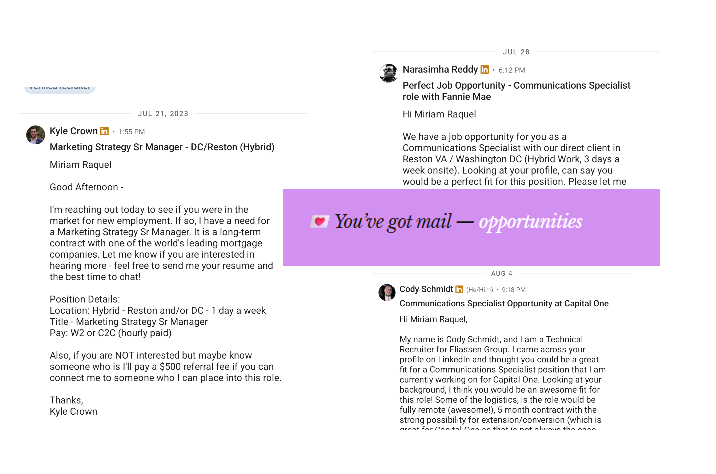
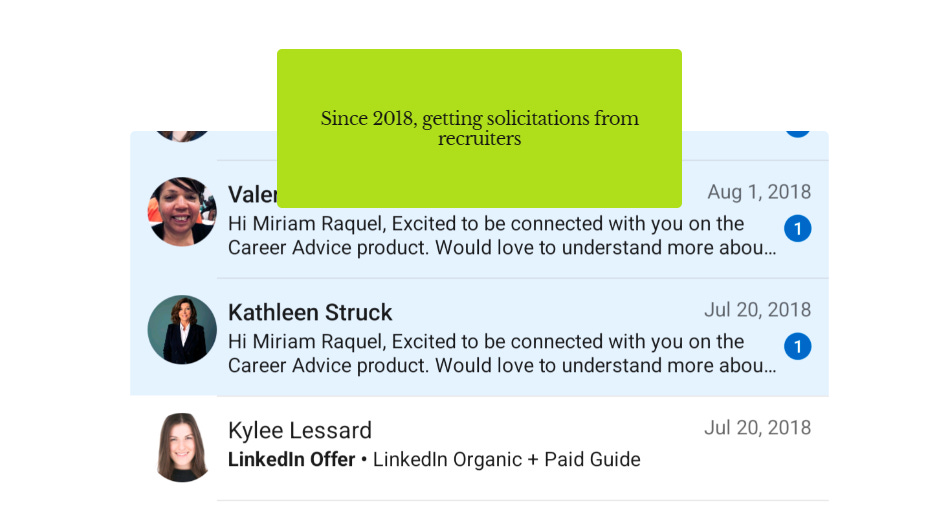
See my LinkedIn inbox since 2018! Getting solicitations from recruiters and agencies to be a contractor (freelancer with a W-2):
More examples of recruiters and agencies reaching out to me on LinkedIn, thanks to my LinkedIn profile and portfolio: