

So this episode is all about time, and I know that might seem kind of random. I often think about how I come up with these episodes, and it’s usually just these realizations I start to have about my day-to-day — I kind of observe myself from the outside, almost an out-of-body thing. I was walking my dogs the other day and started thinking about this feeling of, when is the right time to do something? Or honestly, what even is time?
Because here’s the thing — there’s this perception that when we’re having a great time, when we’re really in the moment, and it’s good, time passes by fast. But when something’s difficult and tense, time can move really slowly; it kind of drags on. So time feels like this liquid, almost a gas — very ambiguous. And yet in science they measure it. There are all these concepts of containing time, all these different calendars around the world, and we plan our whole lives around it.
I started to broaden this thought because — think about work, not having enough time in a day to get things done. Or it takes time to think about things, to actually build a business, whatever it is. So we use this concept that seems finite, seems limited, in this very loose, nuanced way to define and discern so many different areas of our lives. Time is doing a lot of heavy lifting. It’s categorizing and defining basically everything about us.
Who even invented this
The more I thought about it, the more I got curious — who invented this concept? Where did the word even come from? Because when we were more tribal, more nomadic, I’m sure there was a totally different sense of rhythm. Things were happening — the sun comes up, it goes away, there’s all these stars — but there wasn’t a lot of definition. It probably felt kind of chaotic, in this very pre-”civilization,” pre-agricultural way.
And then as agriculture developed, as the wheel and the printing press and all these technologies came along, time became this whole evolution — we needed to measure how long something takes to grow, to harvest, to plow. And I think ever since then it’s become this practice of optimization, efficiency, making the most of our time. We give corn to fish and cows because it’s time-efficient, and we’ve lost quality in favor of quantity.
You can see it now with AI, honestly — a lot of white-collar workers using it to cut down on the time it takes to think or create, and then humans just become editors, fact-checkers, after the fact.
Time is such a curious thing because it’s supposedly measurable — 60 seconds in a minute, 60 minutes in an hour, all contained and verifiable — but it’s actually not, because without that construct we’re all just living the same day, every day. I think this concept of time is really an effort to control — to control our output, our input, to determine fate, to determine the order of things.
Because if you can control how long something takes, the value of it, the efficiency of it — well, that’s scalable. That’s the backbone of so many of our systems.
Where the word “time” actually comes from
I want to get into the etymology a little, because I didn’t know this until I went looking. Time traces back through Old English — tīma — from a much older root that also gives us the word “tide.” Like ocean tide, a wave. And that’s not a coincidence, because “tide” originally just meant a portion, a division of time — before it narrowed down to mean ocean tides specifically.
So even at the root of the word, before any culture’s philosophy ever touched it — time was already understood as a division. A portion. A piece carved out of something continuous. It started fragmented. Like, here’s a piece of the pie.
But I actually love the tide image anyway, even with that older meaning. A tide is a rhythm, not a straight line. It comes in, it goes out, it happens quickly, it happens again. And I think that’s part of why I’ve always struggled with New Year’s resolutions, “new year new you” — because it creates this linear, beginning-and-ending mentality, and that’s just not natural. That’s not how a tide works. One tide isn’t better or worse than another tide. It just is, and then it passes.
How different cultures have held time
There’s linear time, which is the dominant Western frame — a past that’s gone, a future that’s always out of reach because it’s always ahead of us. Then there’s cyclical time, which shows up a lot in East Asian traditions — the lunar calendar, repeating cycles. It’s not “start at A, end at Z.” It comes around, and it comes around again.
And then there’s the Maya — which I think about a lot, since it’s cacao’s own origin culture. They didn’t use just one calendar. They had interlocking systems — a 260-day cycle (I might not be pronouncing that right), a 365-day cycle, and then what’s called the long count, for tracking really vast spans of time linearly. So they held the cyclical and the linear at the same time. They were looking at what’s coming back around, and also what’s the immediate path ahead. Both at once.
And I think the more we can give ourselves the space, the openness to look at time differently, the more it frees us up — mentally, emotionally, in how we manage money, decisions, work, whatever it is — because we’re not putting that pressure on ourselves of having to do something by a certain time just because a calendar says so.
The Greeks, finally
Okay, so this is where my meandering actually took me — I learned the Greeks had two words for time. Maybe they have more; I don’t speak Greek, but these are the two I came across.
Chronos — quantitative time. Clock time. We’re cutting up a pie, dividing it into measures. That’s the quantity; you have a certain amount.
Kairos — and this one’s the interesting one — is qualitative time. Is this the moment to speak, to act, to seize something? Not waiting on Chronos, the clock, but trusting Kairos — that more intuitive, rhythmic sense of, is this the right time, can I trust this moment.
I think so much of our society has been focused on Chronos — what can we measure, extract, optimize — and we’ve lost Kairos, or at least gotten less attuned to it. And I think that matters, because when you live by Kairos — when you understand that every tree, every plant, every herb is growing on its own time, one tree might have more branches or flowers than the tree right next to it, and that’s not measurable, that’s just its own peculiar quality — I think that’s what those of us who value lifestyle over profit, who are more intuitive, more sensitive, need to lean into. Not the “clock in, get paid regardless” version.
The rhythm version.
Because trusting Kairos means trusting yourself — trusting that a right moment is right because of your own internal sense of it, not because a calendar externally told you so. And that forces you to actually stop, pay attention, become aware — because if you’re not attuned to yourself, to how you’re feeling, it gets really hard to make any decision, big or small.
Two questions I’ll leave you with
What would you do differently this season if you measured your life in quality of moments instead of quantity?
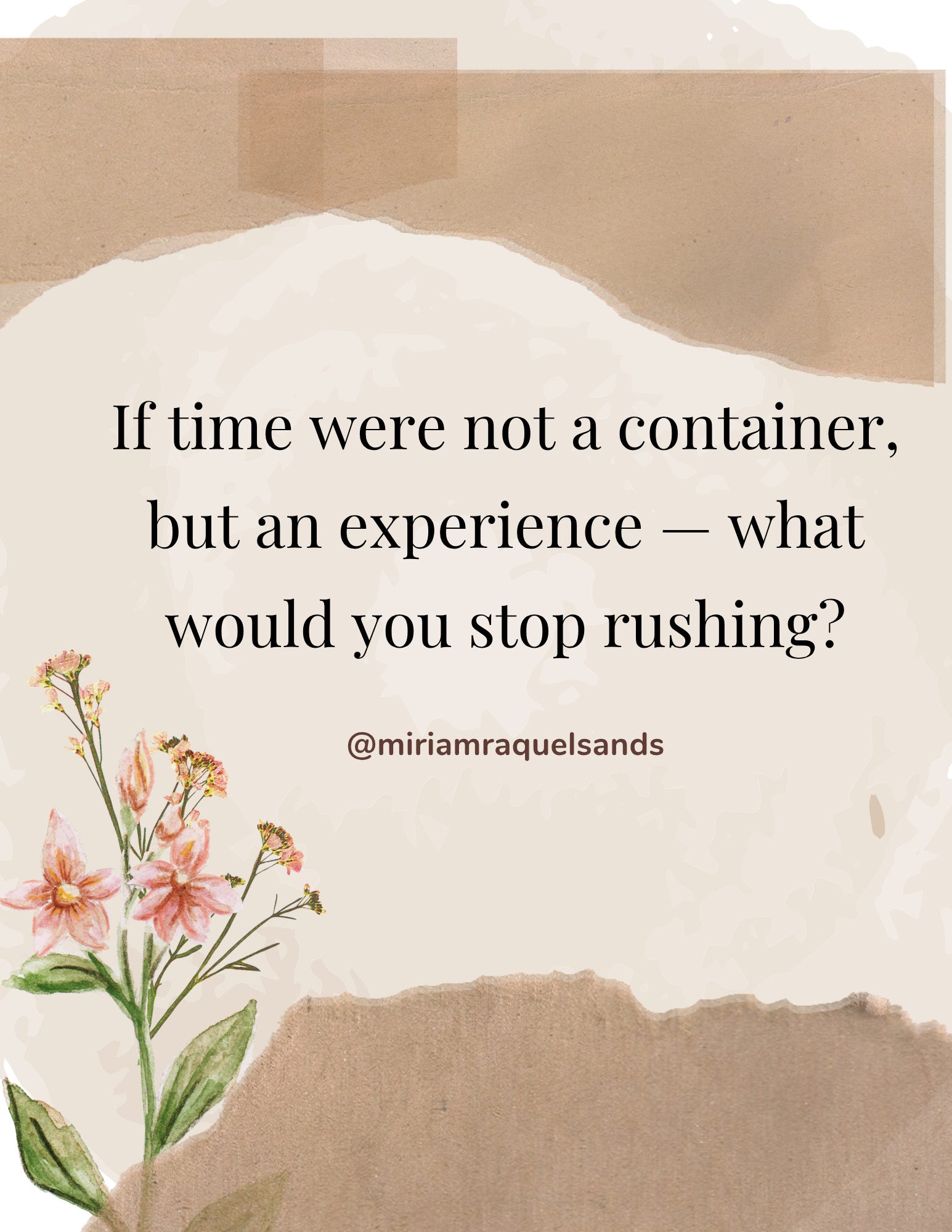
If time were not a container, but an experience — what would you stop rushing?
Just sit with those. Notice what comes up in your body, your mind. And come back to them again sometime, because you might answer differently in another moment — and that’s totally okay.
Share with a friend:
Thank you so much for listening, or reading, wherever you’re catching this. Stick around for the next one — I’m getting into energy, consciousness, silence, what we do when we’re not “doing” anything at all. Until next time, take care.