
We all know that other people have different perspectives, that our experiences shape how we interpret things, and that what makes sense to us might not make sense to someone else.
But I think there is a difference between knowing something and spending enough time with the idea that it begins to change how you understand yourself. Lately, I’ve been thinking a lot about thinking itself.
How do I distinguish the parts that are useful from the parts that are simply interesting? How do I know when understanding something has served its purpose and when I’m just continuing to turn it over?
I’ve followed the thread. I’ve considered different angles. I’ve tried to understand the context, the circumstances, the motivations, the possible interpretations, and the things I might be missing. And now I have all these thoughts, but how do I step back far enough to see what I’ve actually learned?
And that got me thinking about the relationship between the way we think and the way we live.
What if some of the things we struggle with aren’t simply problems that need better solutions? What if they’re also invitations to examine the way we’re approaching them in the first place?
Which is how I ended up in a rabbit hole about slime molds.
1. The slime mold and the question of intelligence
Most of us have learned to associate intelligence with a particular set of abilities: reasoning, memory, communication, planning, and the capacity to respond to increasingly complicated situations.
And because humans possess these abilities, it can be tempting to imagine intelligence as a ladder, with simpler organisms somewhere near the bottom and humans standing triumphantly at the top.
But evolution doesn’t operate like a school system.
There is no universal examination every species is trying to pass, no final form toward which all life is moving, and no guarantee that a more complicated organism is necessarily better suited to every environment.
Evolution favors traits that contribute to reproductive success under particular conditions.
Sometimes complexity is advantageous. Sometimes a simpler structure is sufficient. Sometimes specialization comes with costs that are easy to overlook when we’re busy celebrating what makes an organism impressive.
Slime molds are not actually fungi, despite their name and appearance. They are a diverse group of organisms, and the species most frequently discussed in experiments involving problem-solving is a plasmodial slime mold.
It doesn’t have a brain. It doesn’t have neurons.
It doesn’t have a centralized nervous system coordinating its movements.
And yet, under laboratory conditions, it can navigate mazes, form efficient networks between food sources, respond to chemical cues, and alter its behavior based on previous experiences.
Researchers have investigated how slime molds can retain information about places they’ve explored, how they respond to repeated stimuli, and how their internal rhythms and physical structures contribute to behavior that resembles decision-making.
What fascinates me is that the absence of a brain doesn’t prevent it from performing behaviors we might otherwise associate with intelligence.
How does this organism accomplish what it needs to accomplish without thinking like us?
Intelligence doesn’t have to look like intelligence to us
Rather than relying on a brain to direct every movement, the organism’s behavior emerges through interactions among its internal processes and its surroundings.
This doesn’t mean that slime molds have solved every problem humans face, or that their biology can be directly translated into a blueprint for human life. They have their own constraints, and they operate in a world very different from ours.
But they do challenge the assumption that effective responses to the environment always require a brain.
Think about how often we associate competence with having a plan, an authority figure, a central decision-maker, or a single place where all the important information is supposed to live, aka a brain.
Now think about how often those same arrangements become bottlenecks.
Information gets stuck with one person. A decision can’t be made until someone higher up approves it. A team doesn’t know what another team is doing. People are waiting for direction because responsibility has been concentrated somewhere that isn’t equipped to handle every decision.
And perhaps one of the most useful things we can learn from studying life is that the structure through which a system operates shapes both what it can accomplish and what it struggles to do.
2. The human brain: extraordinary, expensive, and not the whole story
I don’t think we give enough consideration to the fact that our brains are biological organs with material needs. It consumes energy. It depends on the rest of the body to function.
Its abilities come with costs, and those costs are part of the evolutionary story. The adult human brain makes up roughly 2% of body weight but uses about 20% of the body’s energy at rest.
The brain supports a vast range of functions, from regulating essential bodily processes to processing sensory information, forming memories, coordinating movement, and allowing us to plan for events that haven’t happened yet.
We can anticipate a winter and store food before the temperature drops.
We can imagine a bridge before it exists, coordinate hundreds of people to build it, and use it to cross a river.
We can develop a theory, test it, revise it, and pass what we’ve learned to people who haven’t yet been born.
We can also imagine a conversation that hasn’t happened, replay one that ended three days ago, and create seventeen possible explanations for why someone used a period instead of an exclamation mark.
The same cognitive capacities that make planning, reflection, and invention possible can also contribute to rumination, worry, and the tendency to treat imagined possibilities as problems that require immediate attention.
Perhaps part of becoming more intentional about our lives involves learning when to use our cognitive abilities, when to give them room, and when to let something remain unresolved.
3. Evolution isn’t a ladder, and humans aren’t the final destination
There’s another assumption worth examining here: the idea that evolution represents a steady progression toward greater intelligence, complexity, or superiority.
The word evolution comes from the Latin evolutio, associated with the act of unrolling, particularly the unrolling of a written scroll.
The scientific concept of biological evolution developed through a long history of observation and debate. Ideas about how living things change over time existed before Charles Darwin. Darwin’s major contribution, alongside Alfred Russel Wallace’s independent work, was the development of natural selection as a mechanism explaining how heritable variations can become more or less common across generations.
The distinction matters because evolution is often described as though it were an intentional process with a destination.
But evolution doesn’t know where it’s going.
What works under one set of conditions might not work under another. A trait can be advantageous in one context and costly in a different one. There is no single measure of evolutionary success that applies equally to every organism.
Humans have developed extraordinary capacities for abstract thought, cooperation, technology, and environmental modification. These capacities have allowed us to reshape the world on a scale that is difficult to comprehend.
But our achievements don’t mean every other organism is an incomplete version of us.
Each organism exists within a particular set of ecological relationships, constraints, and possibilities.
We are often encouraged to measure success using the same limited set of indicators: productivity, income, status, influence, speed, visibility, or the ability to accumulate more than we had before.
Those measures can tell us something. They can be useful in particular contexts.
But they cannot tell us everything about whether a life is working.
4. Other ways of being: life beyond centralized control
Plants detect and respond to changes in light, gravity, temperature, water availability, physical damage, and chemical conditions. They use signaling pathways, hormones, electrical activity, and other physiological processes to coordinate responses across their bodies. Some plants release volatile chemicals following damage, and those chemicals can influence the responses of nearby organisms.
A plant doesn’t need to think through every possible consequence of a changing environment in order to respond to it.
Its physiological systems have evolved ways of detecting conditions and adjusting accordingly.
Human beings often approach a problem by trying to understand it completely before deciding what to do.
Sometimes that is the right approach. Other situations require a response to the information already available. We don’t have to understand every cause of our exhaustion before acknowledging that we need rest.
And we don’t have to construct a comprehensive theory of our lives before making a small change that improves them.
Fungi: networks that connect and redistribute
Fungal networks can connect biological processes across physical space. Their behavior emerges from growth, local conditions, resource availability, and interactions with other organisms.
They remind us that a system’s capabilities may depend not only on the individual parts but also on the relationships among those parts.
We often focus on individual performance when trying to understand why something succeeds or fails.
Who is the most capable person? Who made the mistake? Who needs more training? Who should be responsible?
Those questions may be necessary, but they aren’t always sufficient. Sometimes the problem is the relationship between the parts.
Sometimes information isn’t moving where it needs to go. Sometimes the incentives encourage people to protect their own work rather than support the wider system.
Sometimes everyone is working hard, but the structure makes coordination unnecessarily difficult.
Sometimes the system needs to change.
5. What slime molds might teach us about the way we think
We have different bodies, different capacities, different needs, and different relationships with our environments. We cannot simply transplant the biological mechanisms of one organism into another and expect the same results.
For me, the value is in the reminder that the outcome does not always depend on the mechanism we expect.
We may be trying to solve a problem with a particular kind of tool because that is the tool we know how to use.
We may be trying to understand a system through a particular framework because that framework has served us before.
We may be repeating a behavior because it once produced a useful result, without noticing that the conditions have changed.
And we may be so accustomed to treating thought as the primary route to understanding that we overlook other forms of information available to us.
Our bodies provide information. Our environments provide information. Our experiences provide information. The responses of other people provide information.
Not all information is equally reliable, and not every feeling should be treated as a factual conclusion. But thinking is not the only way we encounter reality.
And sometimes we need to recognize that the problem may not be a lack of understanding at all. It may be a lack of information, a lack of resources, a poorly designed system, a mismatch between expectations and reality, or a decision that requires action rather than more analysis.
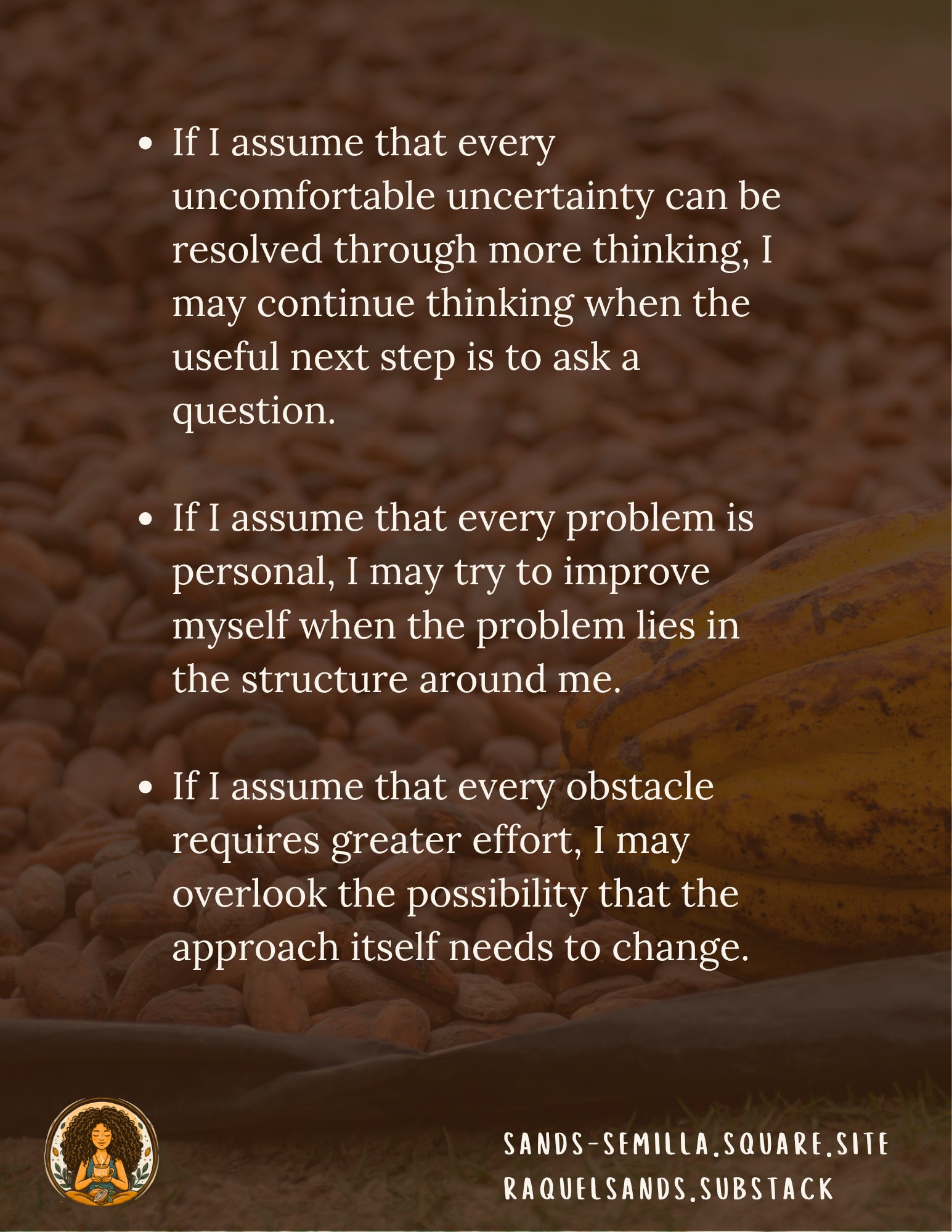
If I assume that every uncomfortable uncertainty can be resolved through more thinking, I may continue thinking when the useful next step is to ask a question.
If I assume that every problem is personal, I may try to improve myself when the problem lies in the structure around me.
If I assume that every obstacle requires greater effort, I may overlook the possibility that the approach itself needs to change.
The question is not simply whether I am capable of thinking through something.
It is whether thinking through it is the most useful response available to me.
6. What are we trying to become?
I think this is ultimately why I found myself so interested in this subject. The slime mold was the entry point, but the deeper question was about the way we understand intelligence, progress, and the possibilities available to us.
What does it mean to live well?
When does thinking help us, and when does it become a way of postponing something else?
What are we trying to accomplish with all the tools, knowledge, and opportunities we have developed?
I don’t have a definitive answer to what humanity should become. I don’t think a slime mold can tell us how to organize a society, and I wouldn’t want to reduce the complexity of human life to a handful of biological metaphors.
Life has produced an extraordinary range of structures, strategies, and relationships. Some are centralized; others are distributed. Some respond rapidly; others operate over longer timescales. Some thrive through complexity; others succeed through relatively simple mechanisms that fit their environments.
None of this makes every strategy equally useful in every context. We are one form of life among many. Our abilities are remarkable, but they exist within a larger world that we did not create and cannot fully control.
The more capable we become of changing that world, the more important it may be to understand the relationships and consequences involved.
And the more capable we become of thinking about our own thinking, the more opportunities we have to decide which thoughts deserve our attention and which actions deserve our effort.
7. A gentler way to think about thinking
If you’ve followed me this far, I want to leave you with something practical, because I know this has been a heady exploration.
But you might find it useful to notice what kind of thinking a situation is inviting from you. You can ask yourself a few simple questions:
What am I actually trying to understand? Sometimes the question we’re exploring isn’t the question we need answered.
What information do I already have? It can be helpful to distinguish what is known from what is inferred, imagined, or still uncertain.
What would change if I thought about this for another hour? If the answer is nothing, perhaps the next step lies elsewhere.
Is this a problem I can solve, a condition I need to manage, or an uncertainty I need to live with? These require different responses.
What is the smallest useful action available to me? Sometimes action produces clarity that continued analysis cannot.
What would it look like to leave this unresolved for now? Not every open question requires immediate closure.
These are invitations, not rules.
There will be situations that deserve extended analysis. There will be decisions where more information is essential. There will be experiences that require time before their meaning becomes clear.
The goal isn’t to force ourselves into a state of perpetual simplicity. It’s to become more intentional about how we direct our attention.
If this essay gave you something to think about, I’d love to know: Where in your life might a different way of thinking, working, or being open up a possibility you haven’t considered yet?
Thanks for following the thread with me.
Share with a friend: