Burnout Isn’t Always Loud: 6 Things I Wish I’d Known About Work, Rest, and Finding My Way Back to Myself
What a decade of working, questioning my career, and learning to listen to myself has taught me about burnout, career sustainability, and the possibility of building a life that doesn’t require...

It’s November, just before Thanksgiving here in the United States, and we’re entering that familiar stretch where everything seems to be happening at once.
We’re making plans to see family and friends. We’re thinking about what to cook, what to bring, where to go, and how to make time for the people we love. We’re trying to create experiences that feel nourishing, meaningful, and worth remembering. Maybe we’re traveling. Maybe we’re hosting. Maybe we’re simply looking forward to a few days when the usual routine looks a little different.
And then there’s work.
Depending on your workplace, November and December can bring a strange combination of circumstances. Things might slow down because people are taking leave, meetings are being postponed, and decisions are waiting until the new year. Or everything might suddenly become urgent because there’s a deadline to meet, a budget to use, a project to finish, a report to submit, or a list of things someone wants completed before everyone disappears for the holidays.
You’re trying to wrap up the year professionally while also making room for your personal life. You’re trying to be present with your loved ones while remembering the email you still need to send. You’re trying to enjoy a meal while thinking about Monday. You’re trying to rest, but part of your mind is already calculating everything you’ll have to catch up on when you return.
And somewhere in the middle of all of this, you might find yourself asking a question you haven’t had the time, energy, or inclination to entertain for the rest of the year:
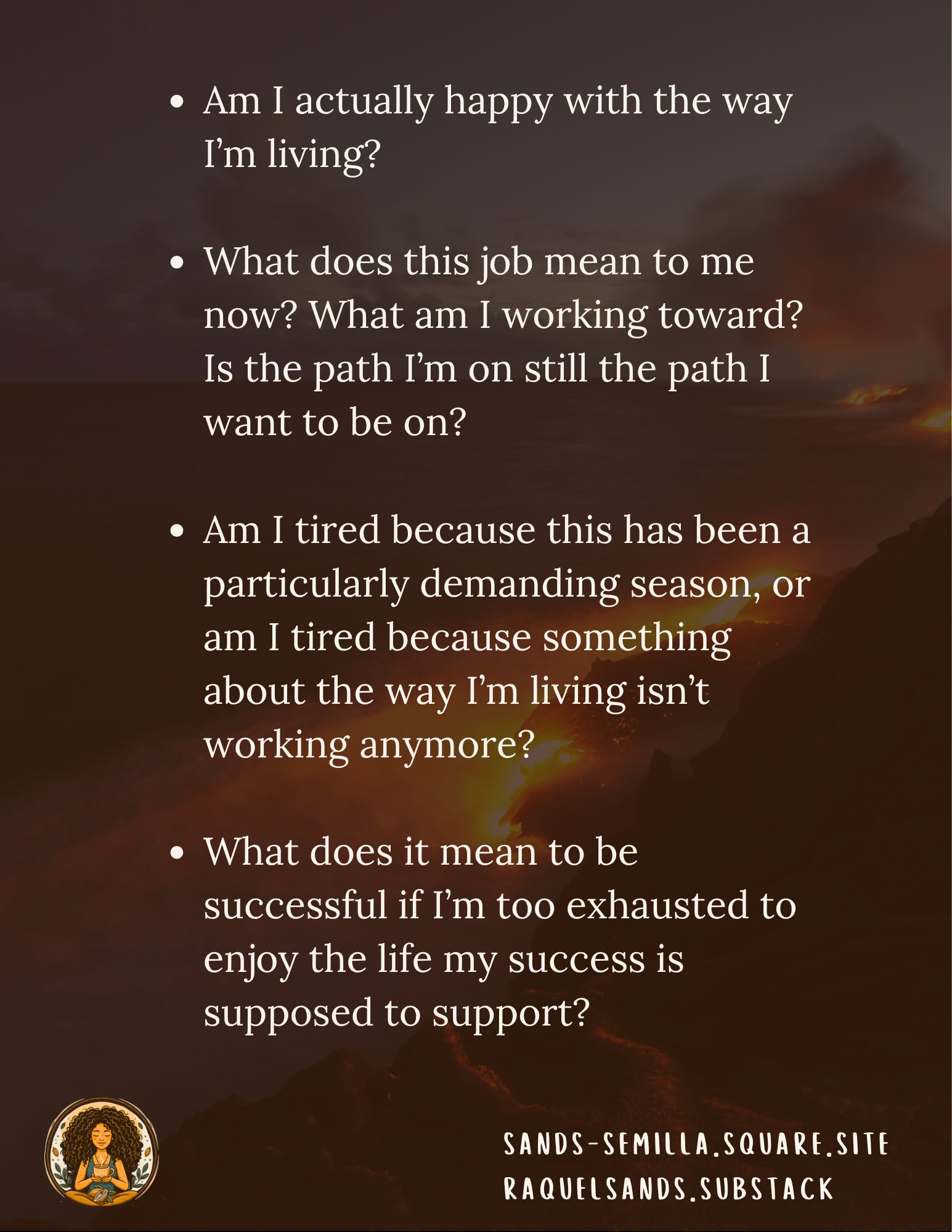
Am I actually happy with the way I’m living?
What does this job mean to me now? What am I working toward? Is the path I’m on still the path I want to be on?
Am I tired because this has been a particularly demanding season, or am I tired because something about the way I’m living isn’t working anymore?
What does it mean to be successful if I’m too exhausted to enjoy the life my success is supposed to support?
And what do I do when I don’t have a clear answer?
When I started my corporate career journey in 2014, I didn’t realize I was already experiencing burnout. From the outside, I could function. Inside, though, things felt flat and heavy. It was as if I were dragging my soul behind me while trying to sound upbeat on Teams.
I didn’t necessarily have the language to describe what was happening. I wondered whether I was being dramatic, whether I needed to push through. I’m sharing this because I know I’m not the only person who has tried to make sense of their relationship with work while continuing to show up for it.
If you’re ending this year feeling foggy, exhausted, disconnected, or uncertain about your career, I hope these reflections offer you a little room to breathe.
1. Burnout isn’t always loud. Sometimes it’s quiet, slow, and invisible.
Sometimes it’s noticing that things you used to enjoy now feel like obligations. You still participate, but the enthusiasm isn’t there. You still accomplish things, but the satisfaction that used to follow has become harder to access.
Sometimes it’s becoming increasingly indifferent to things that once mattered to you.
Sometimes it’s fantasizing about getting away from everything, not necessarily because you know where you want to go, but because the thought of continuing exactly as you are feels unbearable.
You’re functioning. You’re answering messages. You’re making plans. You’re meeting expectations. You’re doing the things people depend on you to do.
But somewhere along the way, you’ve started to feel disconnected from the person doing all of those things.
I think this is one of the more confusing aspects of burnout: the ability to function can make it harder to recognize that something is wrong.
You might even look at other people who appear to be managing more than you and conclude that you simply need to become more disciplined, more resilient, or better at managing your time.
But functioning is not the same as flourishing. Being capable of doing something doesn’t necessarily mean the conditions under which you’re doing it are sustainable.
And being able to tolerate a situation doesn’t automatically mean that you should have to. You can be good at your job and still be struggling with the conditions under which you’re doing it.
Instead of asking only, Can I get through this?, consider asking:
What is it costing me to get through this, and can I sustain that cost?
You don’t need to know the answer immediately. But the question itself can help you look beyond your performance and pay attention to your experience.
Because you are not just the person producing the work. You are also the person living the life around it.
2. You may be experiencing misalignment, exhaustion, or both.
One of the more frustrating things about feeling disconnected from work is that you might not recognize yourself in the experience.
Perhaps you’ve always been someone who enjoys learning, solving problems, creating things, or helping people.
Perhaps you take pride in being thoughtful and dependable. Perhaps you’ve built your career by being resourceful, adaptable, and willing to figure things out.
And now, suddenly, you’re struggling to access the energy you used to bring to those same activities. It’s tempting to interpret that change as a personal failure.
Why am I not as motivated as I used to be? Why is this taking so much effort?
Have I lost my ambition? Am I wasting my potential?
Motivation doesn’t exist independently of our circumstances.
Our energy, interests, responsibilities, health, values, relationships, and environments all influence how we experience work. What felt manageable or meaningful at one point in our lives may feel different as our circumstances change.
If you’re exhausted, you may need recovery and a reduction in demands.
If you’re struggling with an unclear role, you may need better communication, clearer ownership, or a more realistic scope of responsibility.
If your work has become misaligned with your values, you may need to reconsider the role, the organization, or the kind of work you want to do.
And if several of these things are happening at once, it may take time to distinguish between them.
And sometimes the most productive question is, Why am I being asked to tolerate it in the first place?
If you’re continually adapting to an environment that doesn’t provide the information, resources, clarity, or support you need, becoming more adaptable may help you survive the environment without resolving the underlying problem.
This can create a difficult dynamic for thoughtful, conscientious professionals.
The very qualities that make someone valuable—resourcefulness, flexibility, care, and a willingness to help—can make it easier for an unsustainable situation to continue.
It’s learning to recognize which demands are reasonable, which ones require a conversation, and which ones may not be yours to carry.
Misalignment is information, not an automatic verdict
It’s become common to talk about finding work that aligns with your values, purpose, identity, and ideal lifestyle. I understand the appeal. I think it’s valuable to consider whether our work supports the lives we want to live.
The goal isn’t to create a working life in which you never experience discomfort.
It’s to develop a clearer understanding of the difference between ordinary difficulty and a pattern that is undermining your well-being.
A demanding season isn’t necessarily a sign that you need to leave.
A difficult manager isn’t necessarily a sign that you’re in the wrong profession.
A period of low motivation isn’t necessarily proof that you’ve lost your purpose.
But persistent exhaustion, ongoing conflict between your values and your work, or repeated experiences of being unable to meet expectations under the conditions available to you deserve attention.
That is gathering information about your life.
3. It’s okay not to have a five-year plan. Sometimes you just need a next step.
I think one of the most unhelpful things we can do when we’re already exhausted is demand that we figure out our entire future.
You’re tired, disconnected, or uncertain about your current circumstances, so you decide it’s time to overhaul your life.
You compare career paths. You update your résumé. You look at job descriptions. You listen to podcasts about entrepreneurship. You ask people for advice. You make lists of your strengths, weaknesses, interests, and long-term goals.
Before you know it, you’ve turned your exhaustion into another project. Now you have a full-time job that drains you and a second job trying to figure out how to stop being drained by your full-time job.
When our current circumstances feel uncomfortable, having a plan can make us feel as though we’re moving toward something better.
And sometimes we really do need a plan.
But there is a difference between creating a direction and demanding a complete blueprint when we don’t yet have the information, energy, or perspective to make one.
We want to make the right decision. We want to avoid wasting time. We want to ensure that whatever we do next is worth the effort. But no amount of planning can eliminate every unknown.
If you’re feeling uncertain about your work right now, I would encourage you to make the question smaller:
What would make this week feel a little more manageable?
What is taking the most energy from me right now?
Is there a conversation I need to have?
Is there a responsibility I need clarified?
What do I need more of: rest, information, support, autonomy, or a change in circumstances?
Is there one small experiment I could try before making a larger decision?
The point is to identify what is appropriate for your actual circumstances rather than what sounds impressive as a career strategy.
4. Sometimes doing less is the most strategic thing you can do.
We live in a culture that is very good at turning discomfort into an opportunity for optimization.
You’re tired? Perhaps you need a better morning routine.
You’re overwhelmed? Try a new task-management system.
You’re struggling to focus? Download an app, create a schedule, or restructure your workspace.
You’re dissatisfied with your job? Start a side hustle.
You’re uncertain about your future? Update your résumé, build your network, and develop a personal brand.
I like systems when they serve a clear purpose. I appreciate tools that make work easier, reduce unnecessary complexity, and help me organize information.
If you’re already struggling to recover from your existing responsibilities, it’s worth asking whether adding another commitment will help you move toward the life you want—or simply give you more to carry.
The difference between rest and avoidance
I also think it’s important to distinguish between doing less strategically and avoiding something that genuinely needs attention.
There are times when pushing through is appropriate. There are times when we need to do the uncomfortable thing even though we would rather not.
And there are times when we’ve been pushing for so long that continuing to push prevents us from recognizing what the situation requires.
The question is not whether we should always do less. It’s whether the amount and type of effort we’re applying are appropriate to the problem we’re trying to solve.
You are allowed to rest because you are a person who needs rest.
You are allowed to spend time with people you love without thinking about how the experience supports your goals.
And you are allowed to have periods in which you are not actively building toward anything.
And sometimes doing less is simply how you make room for the parts of life that were never supposed to be optimized in the first place.
5. You can’t always solve burnout by changing your circumstances. Sometimes you also have to examine the beliefs you carry into them.
It’s relatively easy to recognize that a job is demanding or that an organization has problems. It’s harder to examine the beliefs that influence how we respond to those circumstances.
Because even when we change jobs, industries, schedules, or working arrangements, we bring ourselves along. And sometimes those patterns continue to influence our experience even after the original circumstances have changed.
For example, you might leave a demanding job and enter a more flexible environment, only to discover that you still feel guilty when you finish work early.
You might become self-employed and find yourself recreating the same rigid schedule you wanted to escape.
These experiences don’t mean the original problems were imaginary. A healthier environment can make an enormous difference.
But they can reveal that there are also internalized expectations worth examining.
6. Burnout recovery isn’t always about leaving your job. But it may change how you think about your career.
I think it’s important to make room for the practical realities of career decisions.
People have rent to pay, families to support, health needs to consider, financial obligations, immigration circumstances, and different levels of access to opportunity. Not everyone can simply resign and figure things out later.
Even when leaving is the right long-term choice, the timing and process matter.
You can recognize that a job isn’t working for you without deciding that you must leave tomorrow.
The goal is to make a thoughtful decision that accounts for your well-being, your needs, your responsibilities, and the options available to you.
For me, this requires asking questions that go beyond the usual measures of career success.
What kind of schedule works for me?
How much autonomy do I need?
What kinds of responsibilities energize me, and which ones consistently drain me?
What working conditions allow me to do good work without requiring constant overextension?
How much uncertainty can I comfortably navigate, and what kind of support helps me manage it?
Our circumstances change. Our needs change. The economy changes. Organizations change. The kinds of opportunities available to us change.
The question is what the trade-offs mean for the life we’re trying to build.
7. The end of the year is not a deadline for figuring out your life.
Because the year is coming to an end, we can feel as though we need to resolve everything before it does.
But a calendar turning over doesn’t mean every open question needs to be answered. You can enter a new year with uncertainty. You can have goals that remain unfinished.
Instead of asking only what you’ve accomplished, perhaps ask what you’ve learned about yourself.
What conditions helped you feel more grounded this year?
What consistently drained your energy?
What did you discover about the kind of work you enjoy?
What responsibilities did you take on that you may not want to continue carrying?
What did you tolerate because you thought you had to?
You don’t need to answer every question. Sometimes it is enough to notice what comes to mind.
8. Questions for your next chapter
I want to offer a few questions you can return to when you have the space and energy to reflect. You don’t need to answer them all at once. You don’t even need to write your answers down.
Consider them invitations to understand your current circumstances a little more clearly.
What am I noticing about myself lately?
Have your energy levels changed? Are you finding it harder to concentrate? Have you become more withdrawn, irritable, or indifferent? Are there activities you used to enjoy that now feel unusually difficult?
Try to observe these changes without immediately judging them.
The goal is not to diagnose yourself based on a list of symptoms. It’s to notice whether something has shifted and whether that shift deserves attention.
What seems to be contributing to how I feel?
Consider your workload, work environment, relationships, health, sleep, finances, and other responsibilities.
Understanding the broader context can help you avoid assuming that everything you’re experiencing is a personal failing or that one dramatic change will necessarily resolve it all.
What is exhausting me, and what is simply challenging me?
Some work is demanding in ways that feel worthwhile. Other work drains us without providing enough value, support, or satisfaction in return.
The distinction won’t always be obvious, but it can help you identify what needs to change.
What is within my control, and what requires cooperation from other people?
You may be able to change how you organize your day, but you may not be able to control the number of projects assigned to you.
You may be able to communicate your needs, but you cannot guarantee how someone else will respond.
You may be able to explore another career, but you may need time and resources to make a transition.
Recognizing these distinctions can help you direct your energy toward useful actions without assuming responsibility for everything.
What do I need more of right now?
Perhaps you need rest. Perhaps you need clarity.
Perhaps you need support, autonomy, flexibility, recognition, or a more manageable workload.
Perhaps you need to explore alternatives. Perhaps you need to stop trying to make a decision until you have more information.
There is no prize for choosing the most ambitious answer. The useful answer is the one that reflects your circumstances.
What do I want work to make possible outside of work?
This question can be especially useful when you’ve spent a long time thinking about career advancement in terms of titles, income, or achievement.
What do you want your income to support?
What kind of time do you want to have available?
What relationships, interests, and experiences do you want room for?
How much flexibility matters to you? What does a sustainable week look like?
Even a few answers can help you recognize which opportunities deserve further consideration.
What am I no longer willing to sacrifice without reconsidering the trade-off?
Perhaps it’s your evenings. Perhaps it’s your health, your relationships, your creative energy, or your ability to recover between demanding periods.
It’s to recognize that trade-offs exist and that you are allowed to participate in deciding which ones make sense for your life.
What is one thing I could do to make my current situation more sustainable?
It might be a conversation. It might be a boundary. It might be taking leave, seeking support, clarifying expectations, or researching an alternative.
If your exhaustion is persistent, severe, or interfering with daily life, consider seeking support from a qualified health professional. Burnout-like experiences can overlap with other physical and mental health concerns, and you deserve support that takes your full experience into account.
You don’t have to figure everything out by yourself. And you don’t have to wait until you can explain everything perfectly before asking for help.
A final reflection:
When I look back at the beginning of my corporate career in 2014, I think about how easy it was to assume that the answer to feeling disconnected was to push through.
Effort can help us move through difficult periods. Discipline can support us when motivation is inconsistent. We sometimes need to persevere through circumstances that are uncomfortable but temporary.
But I don’t think perseverance is the answer to every difficult experience. Sometimes we need to recognize that a path we once wanted is no longer the path we want to continue pursuing.
And sometimes we need to stop treating our ability to endure something as evidence that enduring it is the right choice.
Careers involve real responsibilities and trade-offs. Financial circumstances matter. Opportunities are not distributed equally. Not everyone has the same freedom to change jobs, reduce hours, or take time away.
I don’t want to romanticize those constraints or pretend that a change in mindset can resolve them. But even within our different circumstances, I think we can become more intentional about how we relate to work.
If this resonated with you, I’d love to hear what you’ve been learning about your own relationship with work. Have your priorities changed over time? What has helped you recognize when you need rest, a different approach, or a new direction?
Take what serves you. Go gently. You don’t have to figure it all out today.
Share with a friend:
Discussion about this post